Categories New-posts, Press center

VCHD Cargo cooperates with GLS Germany

The transport company VCHD Cargo has been working closely with parcel service provider GLS Germany since June 2021. For GLS, one of the leading providers of logistics services, VCHD Cargo carries out regular scheduled transports from the Dresden area. The company uses special swap bodies and versatile towing vehicles capable of adapting to different standstill heights as well as low-deck towing vehicles, all of which comply with the highest Euro 6 emissions standard. Thanks to the driver rotation system, excellent delivery times are achieved.

GLS Germany (behind the acronym is the name General Logistics Systems) is a globally active company and a subsidiary of the British Royal Mail. VCHD Cargo has been one of its certified partners since June 2021. “We benefit from the know-how of our experienced drivers from the Czech Republic and the possibility of changing crews and vehicles during unloading on the route to Central Bohemia,” explains Ing. Petr Kozel, CEO and Chairman of the Board of Directors of VCHD Cargo a.s., adding, “The set of two fully loaded C745 swap bodies can hold 36 pallets. That is 9 percent more than a conventional semi-trailer. This not only has the advantage of being able to use more loading capacity, but also reduces the carbon footprint of our transports.”

VCHD Cargo has a fleet of 200 towing vehicles and 180 trailers operating on 73 routes throughout Europe. The company uses two crews on long-distance routes and a system of alternating crews, which allows it to achieve short delivery times even to distant destinations. “Our services are used by logistics, parcel, production and retail companies, which appreciate our flexibility and reliability in delivery. This is the biggest benefit in the current shortage of drivers and vehicles on the market,” concludes Petr Kozel.

About GLS Group

GLS Group is an international parcel services provider with a strong local market expertise. Each day, GLS delivers millions of parcels through its seamless cross-border network. The company takes pride in providing its customers across 41 countries with a hassle-free experience and high-quality service that suits their needs best. With a sharp eye on what matters most – the customer – GLS has a presence in almost all European countries and operates through wholly-owned subsidiaries in Canada and on the USA’s West Coast, all within one GLS network. The GLS network consists of 88 central and regional transhipment points and about 1,600 depots, which are supported by approximately 35,000 final-mile delivery vehicles and 4,600 long-distance trucks. The way GLS actively manages its network and connects its markets gives the company the agility and flexibility to respond to fast-changing conditions in the industry. In 2020/21, GLS generated record revenues of 4.5 billion euros and delivered 840 million parcels, despite global challenges.

 

Categories New-posts, Press center

VCHD Cargo has invested CZK 70 million in new vehicles. A second batch, with nearly the same price mark, has not been delivered yet

The transport company VCHD Cargo has acquired 39 towing vehicles and 20 trailers this year. Partly thanks to its acquisition of the German businesses Völker Logistik, the company’s fleet has thus increased to include 200 trucks, trailers and swap bodies with an average age of 3 years. Investment into vehicle technology alone has reached CZK 70 million in 2021. Nearly half of the vehicles ordered in 2021, worth nearly the same amount, has not been delivered yet due to global problems caused by disrupted supply chains.

VCHD Cargo derives great pride from providing its drivers with the latest in vehicle technology, impeccably maintained. It keeps the average age of its fleet at around three years. “A reliable, safe truck and trailer, with the biggest possible cargo capacity, is the best foundation for satisfying the needs of our customers,” says VCHD Cargo a.s. CEO and President Ing. Petr Kozel. The 59 new additions to the fleet include trucks, swap body carriers and trailers as well as frigo box trailers with regulated temperature and, for the first time in the company’s history, its own swap bodies.

Originally, VCHD Cargo planned to invest nearly double the actual amount, a total of CZK 140 million, in new vehicles. Unfortunately only half of the orders have been delivered. “This deficit has had an impact on several key aspects of our business – first and foremost, the average age of our fleet has increased, resulting in a higher cost of repair. Secondly, we are obliged to maintain more backup vehicles ready to replace units that require servicing,” Petr Kozel explains, adding: “In fact, the vehicles that were delivered to us this year were not even enough to cover our planned fleet renewal.”

Since delays in the supply chain have now reached and sometimes exceed 6 months, VCHD Cargo must plan its vehicle investments and orders as much as a year in advance. Next year, the company will purchase new vehicles from MAN, Mercedes, Scania and Volvo.

Categories New-posts, Press center

VCHD Cargo’s Millionaires’ Club hits the 2.5m km mark for the first time

The transport company VCHD Cargo has created and supports its Millionaires’ Club for drivers who have travelled over a million kilometres behind the wheel of the company’ trucks. After the very difficult year 2021, three club members reached the 2m km milestone. However, the overall champion is Jiří Kadlec, driver at the Kladno branch, who hit the 2.5m km mark this year. Each year, VCHD Cargo treats its millionaire drivers to interesting benefits.

“The Millionaires’ Club is also a club of our most experienced drivers,” says Jiří Kadlec, VCHD Cargo’s CEO and President, adding, „some of them have been with our company for decades and act as coaches for young drivers who enter our driving school. We greatly appreciate their dedication and we do our best to let them know that they are our company’s most valuable asset.”

Experienced and loyal drivers are a rarity in the labour market. In VCHD Cargo’s experience, young drivers who just get their first driver’s licence are far from ready to face the challenging traffic on European roads. The company has, therefore, set up a system of in-house and external coaches who train newcomers and help them adjust to their new job. „There is a long-term lack of professional truck drivers in the labour market and the coronavirus crisis has only made the situation worse. Drivers are under an ever increasing pressure due to new restrictions and rules that have raised the bar to the hiring of foreign workers,” Petr Kozel explains. VCHD Cargo strives to create conditions that make our drivers’ tough job as easy as possible. Experienced support staff is available to drivers on the phone 24 hours, 6 days a week. The company has the most advanced fleet and our drivers are helped by smart technologies. VCHD Cargo continues to digitise in order to ease the administrative burden on our drivers. “All our vehicles are equipped with modern tablets that dispatchers use to communicate with drivers. Furthermore, we have also rolled out digital drive logs, a tool that has been greatly appreciated by our drivers,” says Petr Kozel. VCHD Cargo drivers also enjoy many company benefits and the most experienced among them receive special bonuses each year as members of the Millionaires’ Club. There are currently 22 members and the Club is open to any VCHD Cargo employee dedicated to the trucker profession.

Categories New-posts

Demand exceeding offer and current market situation

Two years ago, the most pressing problem plaguing carrier companies was the lack of professional drivers. The corona crisis has only deepened this trend and has brought about many other serious challenges.

There is a lack of professional drivers everywhere in Europe and although VCHD Cargo has been able to buck the trend and actually increase the number of our drivers we keep a close eye on the situation. As things stand at the moment, global supply chains are very shaky and the European market sees demand for transport services hugely exceeding offer. This has been driven by a number of factors such as a swift recovery of European economies after the first wave of covid and, as I already mentioned, a chronic lack of drivers but there have been other unforeseen issues as well including longer delivery dates on new trucks and, most importantly, great shifts in the market. Consumer habits and preferences have changed with a skyrocketing demand for parcel delivery services on the one hand and a collapsing sea shipping industry responsible for bringing cheap goods from Asia on the other hand. Supply chains have been disrupted making freight planning extremely complicated across the globe as well just within Europe. And when planning gets complicated in our business it becomes increasingly difficult to fully leverage vehicles and quickly respond to demands for extra capacity.

A solution of this situation in Europe, the region that concerns us the most, requires first and foremost a more predictable intercontinental traffic. In the long term, however, other crucial steps forward are increasing the prestige of the truck driving profession and improving comfort and services for drivers (such as building more rest stops with high-quality amenities on key backbone routes), rollout of technological innovation and systemic changes. Unfortunately, drivers continue to see little sympathy for their plight and the market shows little willingness to embrace innovations. The only truly progressive change that we have seen recently is the wider use of land trains. There has long been talk about autonomous driverless vehicles but no quick and significant development can be expected in this respect in the near future. As for systemic changes, commercial exchange within Europe continues to grow in intensity. Efforts to boost local consumption have completely failed and demand for long-distance freight keeps increasing. It might seem that carriers such as VCHD Cargo would see this as excellent news. But if we step back and consider the wider context, we must realise that this trend is not sustainable on any level – be in it in terms of price, staff or the environment.

Categories New-posts, Press center

We are betting on the swap bodies

VCHD Cargo has added swap bodies to its fleet. By acquiring these special freight containers for road transport, the company will be able to offer to their customers more flexibility of shipment planning and a more efficient use of the loading space. A tandem vehicle with swap bodies provides 13% more in loading capacity compared with a regular trailer. The company will use the swap bodies primarily to serve parcel shipment customers.

VCHD Cargo owns its own fleet of 200 towing vehicles and 180 trailers. The company has recently added a new type of trailer – the swap body – to its portfolio. “Swap bodies are a great solution for certain types of line services as they can also be used as flexible and temporary storage units. They also allow us to maximise vehicle utilisation and minimise loading and unloading times,” says Ing. Petr, Kozel, CEO and President of VCHD Cargo a.s., emphasising that “this is a huge benefit given the current constant pressures on the speed of delivery.”

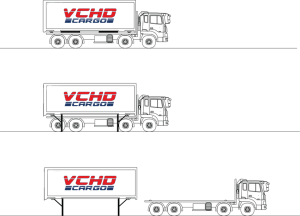
Swap body manipulation  – detaching from the vehicle

A swap body is similar to a regular shipping container. It has standard parameters and dimensions and up-folding legs designed for easy detachment from the vehicle. VCHD Cargo monitors statistics on the utilisation and efficiency of its vehicles and, compared with standard trailers, swap bodies prove to be a more efficient solution. “From practice we know that a tandem vehicle with one trailer and two swap bodies can be more economical in certain situations both in terms of time and in terms of money – one driver can serve the same number of customers in a shorter amount of time. As many as three drivers can alternate on the same vehicle so that it is in use practically 24 hours a day. What’s more, swap bodies are very easy and safe to manipulate with,” Petr Kozel lists the advantages and ads that “the entire process of swapping one swap body for another takes an experience driver approximately 15 to 20 minutes, which saves a huge amount of time if we consider that the vehicle does not have to wait for goods to be loaded. This allows a very high degree of accuracy on delivery.” Furthermore, VCHD Cargo appreciates the longer distances that swap body vehicles can achieve.

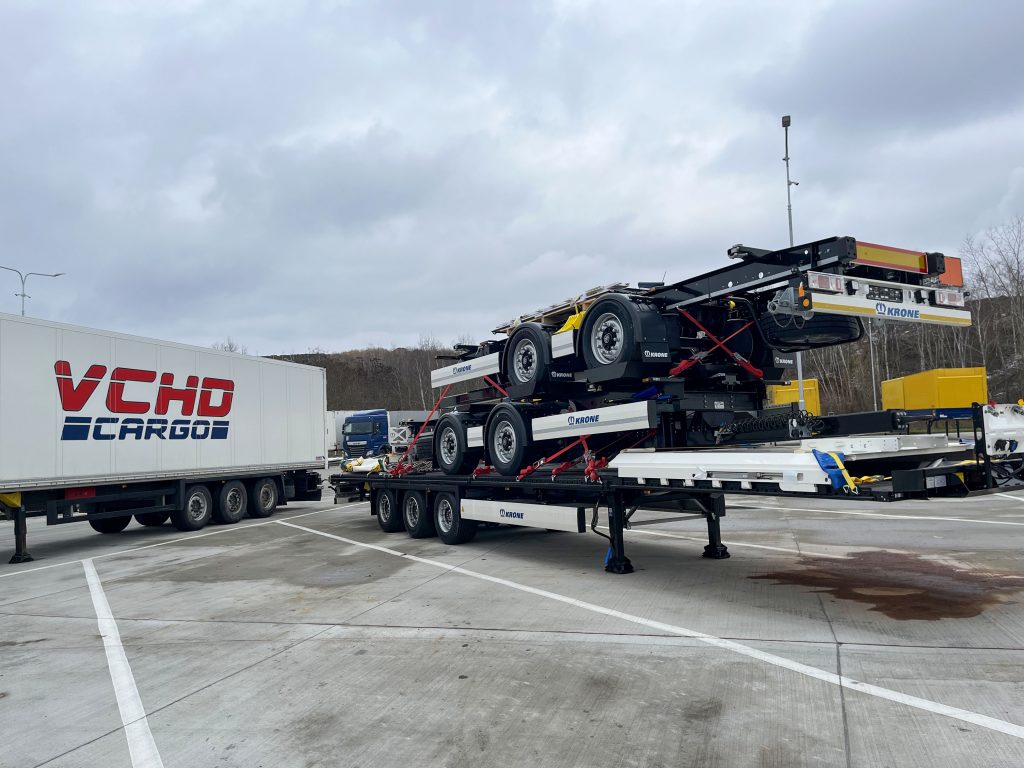
VCHD Cargo acquired C782 swap bodies with dimensions of 7820 x 2550 x 2750 mm (l x w x h) and maximum total weight of 18 tonnes. Thanks to the internal dimensions, a tandem vehicle with two swap bodies can carry 38 EUR-pallets, which is 5 pallets more than what a regular trailer can fit in. Another advantage is the rear roller shutter and the possibility to stack up to three empty swap bodies on top of each other.

“Considering how long delivery times are at the moment, we are very happy that we have decided to order the swap bodies this spring before the acute steel shortages that have since hit the global markets and that have affected the production of swap bodies as well as other towing vehicles and trailers,” Petr Kozel reflects on the current market situation, concluding “we will use swap bodies primarily to serve parcel customers.”