
The debate on reducing emissions from road transport often focuses on new emissions standards, more advanced engines and the gradual renewal of vehicle fleets. A model developed by the international transport company VCHD Cargo, based on its own operational data, shows the difference eco-driving can make in vehicles already in operation. The key factors are professional drivers, regular feedback and a well-designed company incentive scheme.
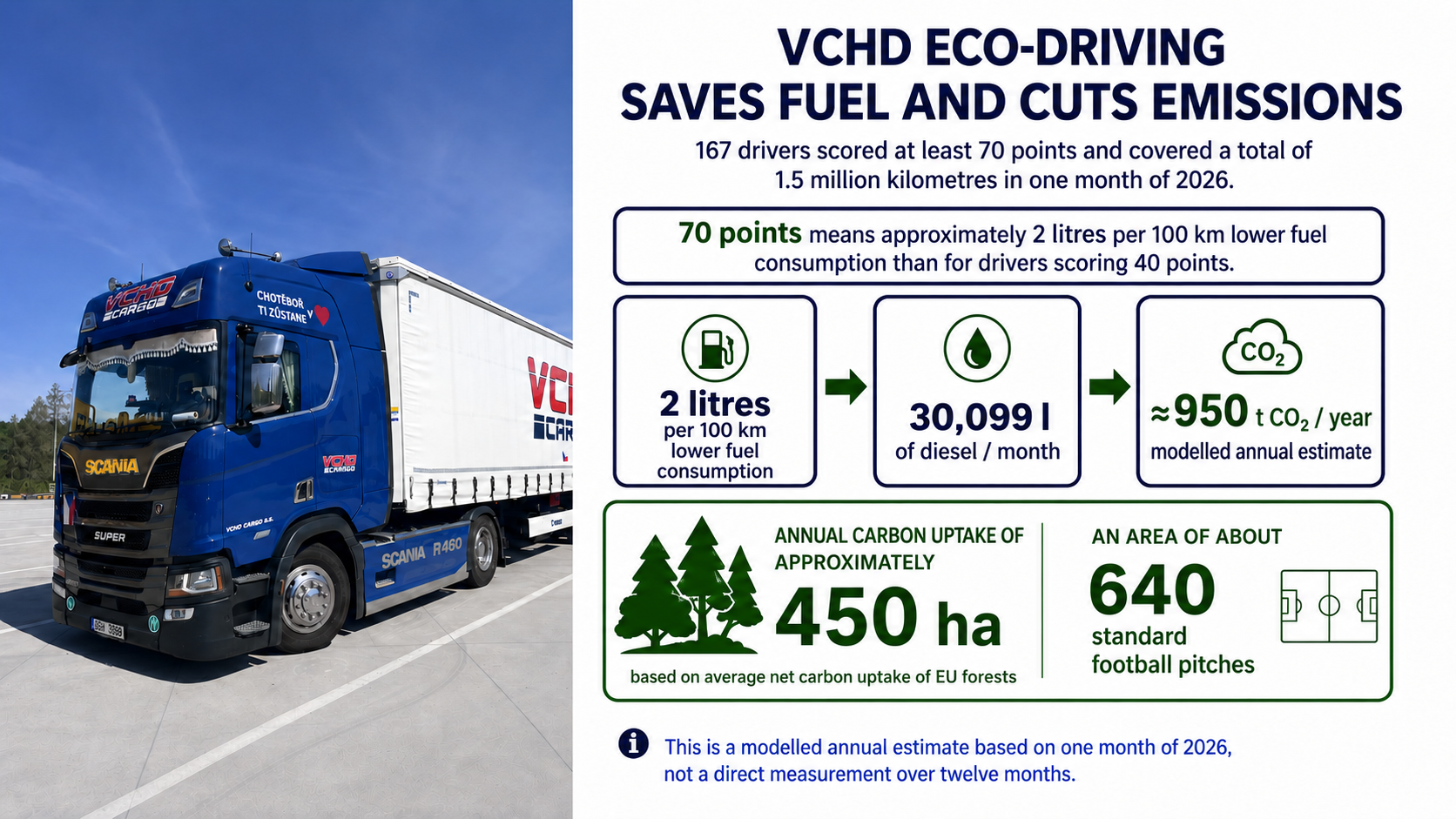
VCHD Cargo compared its internal eco-driving scores with the vehicles’ actual fuel consumption. In one month analysed in 2026, a total of 167 VCHD Cargo drivers achieved at least 70 points out of 100 in the eco-driving assessment. Together, they covered more than 1.5 million kilometres. Assuming a modelled fuel-consumption difference of 2 litres per 100 kilometres between scores of around 40 and 70 points, this mileage corresponds to 30,099 litres of diesel per month. If the same monthly mileage and driver composition were maintained throughout the year, the annualised figure would be 361,188 litres of diesel and approximately 950 tonnes of direct CO₂ emissions. This is a modelled scenario based on one month, not a direct measurement over twelve months or the exact saving achieved on every individual journey.
Key figures from the modelled calculation
- 167 VCHD Cargo a.s. drivers achieved at least 70 points out of 100.
- Together, these drivers covered 1,504,950 kilometres during the month analysed.
- A modelled fuel-consumption difference of 2 l/100 km corresponds to 30,099 litres of diesel per month.
- At the same mileage throughout the year, this would amount to 361,188 litres of diesel.
- The annualised figure corresponds to approximately 950 tonnes of direct CO₂ emissions from diesel combustion.
- Based on the average net carbon uptake of EU forests, an indicative area equivalent is approximately 450 hectares of forest, or about 640 standard UEFA football pitches.
Lower fuel consumption starts behind the wheel
The European Union is gradually tightening the technical requirements for vehicles. The Euro 7 standard sets limits for pollutant emissions from heavy-duty vehicles and also covers particles from brakes and tyres, but it does not set fuel-consumption limits or CO₂ emissions targets. It will apply to new types of heavy-duty vehicles from 29 May 2028 and to all new heavy-duty vehicles from 29 May 2029. Separate European rules also set targets for manufacturers to reduce CO₂ emissions from new heavy-duty vehicles. Their effect will emerge gradually as new vehicles are manufactured and fleets are renewed. Transport companies, however, can influence driving style today.
Every unnecessary acceleration, late braking manoeuvre or failure to make use of the vehicle’s momentum results in additional fuel consumption. For a single vehicle, the difference may not appear significant at first glance. But when the same situations occur every day, involving hundreds of drivers and millions of kilometres, they create considerable scope for savings.
VCHD Cargo therefore takes a long-term approach that focuses not only on advanced technology but also on driver behaviour. It has developed its own system combining objective assessment, daily feedback, training and financial rewards based on the results achieved.
How VCHD Cargo assesses eco-driving
VCHD Cargo’s internal system assesses eco-driving on a scale of up to 100 points. It monitors factors including smooth driving, anticipation, coasting without fuel consumption, maintaining a constant speed, harsh acceleration and braking, and driving at high speed under load. Seventy points represents a practical and attainable threshold for a driver who actively focuses on eco-driving, monitors their results and applies the recommended habits in everyday operations. During the month analysed, a total of 167 of the 268 drivers assessed achieved at least 70 points—more than 62%.
A highly rated driver does not necessarily have to drive slowly. What matters is monitoring traffic, responding in good time, making use of the moving vehicle’s energy and limiting situations in which unnecessary braking has to be followed by additional fuel consumption to regain the original speed. VCHD Cargo drivers can view their assessment for the previous day on their in-cab tablet, including the individual areas on which they should focus. This daily digital feedback is supplemented by the company’s practical guide, training and financial rewards based on the monthly result achieved. Drivers therefore know what is being assessed, can monitor their own progress and have a concrete incentive to improve.
“Measurement alone has never saved a single litre of diesel. Drivers must understand their result, have rapid access to it and have a reason to improve. We have extensive experience of combining data, daily feedback, training and financial rewards. This enables us to take eco-driving out of spreadsheets and put it into practice,” said Petr Kozel Jr., Chief Operating Officer and Vice-Chairman of the Board of Directors of VCHD Cargo a.s.
Technology and motivated drivers complement each other
VCHD Cargo does not regard eco-driving as a substitute for more advanced vehicles or European emissions requirements. It does, however, show that transport companies do not have to wait for the next generation of technology before reducing fuel consumption.
“Manufacturers must develop vehicles that are increasingly cleaner and more fuel-efficient. But it is the transport company that determines how efficiently those vehicles actually operate. We have developed a system that gives drivers data, clear rules and financial rewards based on their results. The results show that when the system is properly designed, the majority of drivers make a genuine effort to drive economically,” added Petr Kozel Jr.
A well-designed eco-driving system can already have an effect within the existing fleet. In addition to lower fuel consumption, it supports smoother operations, reduces wear and tear on vehicles and promotes safer driving.
VCHD Cargo has long focused on economical and defensive driving. This model-based data analysis follows the internal VCHD EcoDrive Challenge 2025, in which the company recognised drivers with the best and most significantly improved driving styles.
Calculation methodology
To quantify the potential benefits, VCHD Cargo compared historical operational data on drivers’ scores with the vehicles’ actual fuel consumption. The data showed a statistical relationship: as scores increased, average fuel consumption decreased. However, consumption is also affected by the vehicle, season, load and route characteristics. The company therefore used two model estimates:
- A model taking the specific vehicle and calendar month into account calculated the difference between scores of 40 and 70 points at approximately 1.83 litres per 100 kilometres.
- A second model, based on the overall relationship between the assessment score and fuel consumption, indicated a difference of approximately 2.38 litres per 100 kilometres.
For the calculation presented publicly, VCHD Cargo therefore used the rounded figure of 2 litres per 100 kilometres. This lies between the results of the two models. The models confirm a relationship in the operational data, but do not in themselves establish a causal saving for every journey, nor do they isolate all the effects of load and route. The comparison between 40 and 70 points was chosen deliberately. In VCHD Cargo’s internal system, a score of around 40 points corresponds to limited use of the recommended driving habits, while 70 points represents an attainable threshold for an active and consistent approach to eco-driving.
Drivers with a score of at least 70 points covered a total of 1,504,950 kilometres during the month analysed.
1,504,950 km ÷ 100 × 2.0 l = 30,099 litres of diesel
If the same mileage and driver composition were maintained for twelve months:
30,099 l × 12 = 361,188 litres of diesel
A factor of 2.6308 kilograms of CO₂ per litre of diesel was used to convert fuel consumption into direct emissions. This factor is derived from the ratio between the real-world emissions of 181.0 g CO₂/km and fuel consumption of 6.88 l/100 km stated in the European Commission report:
361,188 l × 2.6308 kg CO₂/l ≈ 950,213 kg CO₂
Assuming the same monthly mileage, the modelled annualised figure would therefore correspond to approximately 950 tonnes of direct CO₂ emissions.
This is an annualised calculation based on one month analysed, not a direct measurement of twelve consecutive months. The calculation covers direct emissions from diesel combustion, not the fuel’s entire life cycle.
The forest-area equivalent is based on average net carbon uptake of 332.6 million tonnes of CO₂e per year between 2020 and 2022 and a total EU forest area of 159 million hectares:
332.6 million t CO₂e ÷ 159 million ha = 2.09 t CO₂e/ha/year
950.2 t CO₂ ÷ 2.09 t CO₂e/ha/year ≈ 454 ha ≈ 450 ha
An area of 454 hectares corresponds to approximately 636 football pitches measuring 105 × 68 metres, or 640 standard UEFA football pitches when rounded. This is merely an illustrative area equivalent, not an offset of emissions through afforestation.
Sources
- The number of drivers, their scores, their combined mileage and the relationship between scores and fuel consumption are based on internal operational data from VCHD Cargo a.s.
- Information on the Euro 7 standard is based on Regulation (EU) 2024/1257 of the European Parliament and of the Council.
- CO₂ emissions targets for new heavy-duty vehicles are described on the European Commission’s page on lorries, buses and coaches.
- The conversion of diesel consumption into direct emissions is based on the European Commission report on the real-world fuel consumption and emissions of vehicles.
- The figure for CO₂ uptake by European forests is based on data from the European Commission’s Joint Research Centre and the Forest Information System for Europe.